
Our tips for choosing the best domain name
Choosing the right domain means starting off on the right foot. Here's what to consider to find a name that's clear, memorable and suited to your project.

What is a domain name?
A domain name is the address of a website. It is made up of a name and an extension.
www.neoflux.it
Subdomain
Name
Extension

.IT .COM .EU? How to choose the extension for your domain name?
Here are two criteria to consider when choosing your domain's extension:
1
Consistency between the domain name, its extension and the content of the site
An association or an organisation will more often choose extensions like .ORG, while a professional business may opt for a descriptive extension such as .STUDIO or .AGENCY. What matters is that the name and extension consistently convey what you do.
2
The audience or market it targets
An extension like .SHOP is ideal for an online store, while a .IT domain is the natural choice for an SME whose customers are in Italy.
Generic extensions (gTLDs)
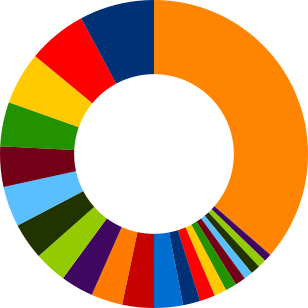
These are the best-known and most widespread extensions: they give your project an international reach and suit almost any kind of website. Among the most used:
Today these extensions work well for almost any type of website and have become part of everyone's habits: for many people it's natural to complete a company's name with a .COM. That's why, if you register a .IT domain and the matching .COM is free, it can be a good idea to register that too: you stop someone else from using it and protect your name.
Country extensions (ccTLDs)
If your project is tied to a specific area, a national (or regional) extension is the right choice: it immediately tells your audience who you're speaking to. For example:

By country
If you're addressing several countries at once, you can register the national extension of each: you strengthen your local presence and the project's credibility in the eyes of the right audience.

New generic extensions (New gTLDs)
Beyond the traditional extensions there are many new, more specific ones that let you tie the name even more closely to your business: for example .shop, .studio, .agency, .tech, .online.
They're useful when you want to be immediately clear about what you do and stand out from the rest. If you find an extension that describes your business well, it can be worth registering it alongside your main name.

Key points for choosing the right extensions

1
Choose an extension that fits your project and the audience you're addressing: it helps people understand right away what you do.
2
Think about the geographic market: a local extension like .it speaks to the Italian audience, while a generic one like .com addresses a wider audience.
3
Favour a name and extension that are easy to read and remember: that way people looking for you find you without mistakes and recommend you more easily.
4
A recognisable extension conveys trust. When you can, also register the main variants (for example .it and .com) to protect your name.

Three tips for finding your domain name

Choose a simple, short name
A short name that's easy to write and pronounce is easier to remember and spreads more readily by word of mouth.

Avoid overly complex combinations
Hyphens, numbers or difficult words make a domain easier to misspell and forget. Go for a clear, intuitive combination of words tied to what you do: if you make great pizzas, a name like 'delipizza' works better than a convoluted combination.
Check availability before defining your project
Before printing business cards or launching the site, make sure the name (and the extensions you're interested in) are really free. Checking in good time saves you from having to rethink everything on the fly.
It's time to transfer your domain name to us

What to do if the domain you want is already taken?
1
Consider an alternative extension
If the domain you wanted is taken, try another extension that fits your project, such as .it, .eu or a new extension related to your business. It's often the quickest solution.
2
Change or shorten the name
Sometimes a small change is enough: shorten the name, drop a word or choose a variant consistent with your brand. That's often how you find a free domain that works just as well.
3
Buy back the domain name
If you really need that name, you can try to buy it back. Find the owner's contact details with NeoFlux's Whois tool and try to negotiate the purchase.


The case of premium domain names
Designated as high-value domains, these domain names are put up for sale on the market by the registrars that had previously reserved them.
Registrars freely set the price of the domains they own. As they are often highly strategic, competition to acquire these domains is greater, so the price can be very high.
Cybersquatting case
It's possible that the domain name of the brand you represent has been registered by third parties for profit (a page full of ads, a page meant to promote the resale of the domain name in question, an illegal online storefront that fakes the brand's identity, or an owner who won't give up the domain name yet doesn't use it).
Book your domain name
NeoFlux's domain name registration tool lets you instantly check the price and availability of a domain name.
Once you've found the right name and the extensions you're interested in, it's worth registering them right away: a good free domain often doesn't stay that way for long. Check availability and book your name without waiting.